Pre-built blog components
Post list with thumbnails, full-article page, carousel and a single-post embed you drop into any page by passing its blogpostSlug.

This package connects Salesforce Commerce Cloud with Contentful so editors publish blog content in Contentful and the storefront renders it. It ships pre-built React components for PWA Kit (post list, full-article page, carousel, single-post embed and category filtering) plus an SFRA cartridge, and reads every entry live through the Contentful API.
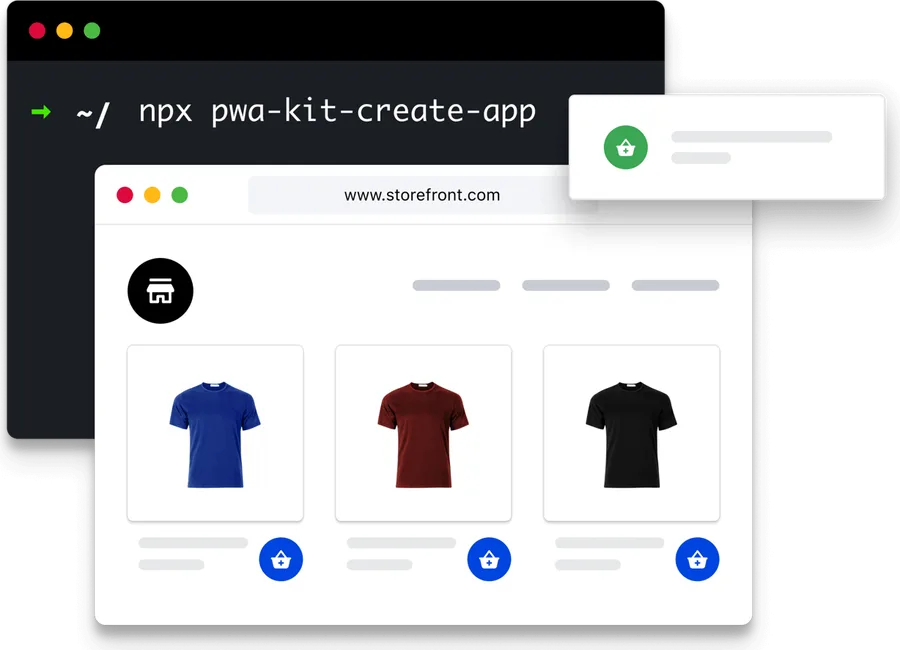
Production-ready functionality delivered as an ISV package for Salesforce Commerce Cloud.
Post list with thumbnails, full-article page, carousel and a single-post embed you drop into any page by passing its blogpostSlug.
Posts carry a Contentful category (taxonomy), and the blog views can filter listings by category for navigation.
Components query Contentful at render time: entries published or edited in Contentful reflect automatically on the storefront, with no site redeploy.
Posts are Contentful entries with Title, Slug, Image and Category fields. Editors set authors and publication dates, and embed images from the Contentful media library.
Article pages keep the PWA's design and branding, render headers and media from the entry structure, and work on mobile layouts.
Server-side routes provide the same blog pages on classic SFRA storefronts.
Example themes for the detail and embed views, so post pages match the storefront design.
Watch the Contentful Blog Headless Integration features in action on real SFCC storefronts. More walkthroughs on our YouTube channel.
Publish product guides, style stories and company news in Contentful; they appear on the commerce site without developer involvement.
Add blog sections to a PWA Kit project with the included components instead of building a content integration from scratch.
Keep editorial workflow in a dedicated CMS while transactions stay entirely inside Salesforce Commerce Cloud.
A merchandiser queues launch-week articles as drafts with future publication dates in Contentful, and the storefront picks them up on schedule with no release involved.
Marketing owns titles, slugs, images and categories in Contentful; engineering owns the storefront codebase. Each team works in its own tool instead of trading tickets for copy changes.
A blog that renders as part of the storefront domain gives content marketing a surface for organic traffic without a separate site to integrate.
Content stays in the Contentful space you already use; the storefront only consumes it.
The preview and publish lifecycle happens in Contentful and updates show on the storefront automatically.
Because posts are fetched at render time, routine content changes never trigger a commerce deployment and cannot break checkout.
Article pages reuse the storefront's design, navigation and mobile behavior, so the blog feels native rather than embedded from elsewhere.
List, detail, carousel, embed and category filtering are ready to compose into routes; the demo and README show each one in use.
Authors, publication dates, rich media and taxonomy keep working the way editors already manage them in Contentful.
After buying the package on AppExchange, install it in a sandbox and follow the setup guide in the preview repository. When it behaves as expected, promote it to production. If you would rather not run the rollout yourself, implementation in your SFCC instance is available as a fixed-price service.

Paid add-on required: this solution works with products or services external to Salesforce. Discounts are available for nonprofits.
The license ships the package. These fixed-price services cover everything around it.
We install and configure the package in your SFCC instance, wire it to your sites and price books, and validate every flow in your sandbox before production.
Version updates that track Salesforce B2C Commerce API and PWA Kit changes, plus priority fixes. Your package keeps working through every platform release.
UI adaptation of the package components - store picker, badges, modals, buttons - to your storefront design system and brand guidelines.
The preview repo lets you inspect the package architecture, components and setup instructions before you buy. It is a structural preview: the full production code ships with your licensed package.
Open preview repository PreviewAll packages are published by AppSpring as a Salesforce ISV partner since January 2023.
Tell us about your SFCC instance and we'll send a fixed-price plan with timeline.
The names and details of our white-label consultancy portfolio are subject to a Non-Disclosure Agreement (NDA), so we can't list them publicly. Tell us who you are and we'll share more with you directly.
We'd love to connect you with our client for a quick recommendation call. Please note that this is subject to the client's availability — more recent clients tend to be more open to such conversations. If the specific client isn't available, we'll do our best to connect you with another satisfied client who worked on a similar project.